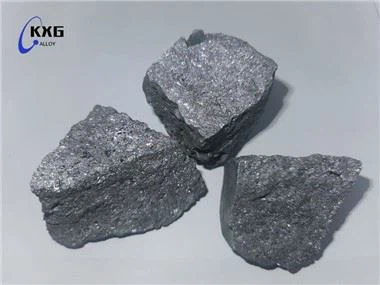

what is the difference between silicon and ferro silicon
Jun 09, 2025
Silicon and ferrosilicon are both important industrial materials, but they have distinct compositions, properties, and uses. Here's a breakdown of their differences:
1. Composition
Silicon (Si)
Pure elemental silicon (98–99.9% purity).
A metalloid (properties between metals and non-metals).
Extracted from silica (SiO₂) via carbothermic reduction in electric arc furnaces.
Ferrosilicon (FeSi)
An alloy of iron (Fe) and silicon (Si).
Typically contains 15–90% silicon, with the remainder being iron and small impurities (Al, Ca, C, etc.).
Common grades: FeSi45 (45% Si), FeSi75 (75% Si).
2. Production Process
Silicon is made by reducing high-purity quartz with carbon in an electric furnace:
SiO2+2C→Si+2COSiO2+2C→Si+2CO
Ferrosilicon is produced similarly but includes iron (scrap or iron ore) in the mix:
SiO2+Fe+C→FeSi+COSiO2+Fe+C→FeSi+CO
3. Key Properties
| Property | Silicon (Si) | Ferrosilicon (FeSi) |
|---|---|---|
| Melting Point | ~1414°C | ~1200–1300°C (varies by grade) |
| Density | 2.33 g/cm³ | 5–6.5 g/cm³ (higher due to Fe) |
| Conductivity | Semiconductor | More metallic (conducts electricity better) |
| Appearance | Dark gray crystalline solid | Silver-gray metallic lumps/powder |
4. Applications
Silicon (Pure Si)
Semiconductor industry (electronics, solar cells, chips).
Silicones & polymers (lubricants, sealants).
Aluminum alloys (as a hardening agent).
Ferrosilicon (FeSi)
Steelmaking (deoxidizer, alloying agent to improve strength).
Cast iron production (graphitizer, improves fluidity).
Magnesium industry (used in Mg production via Pidgeon process).
Military applications (incendiary devices due to exothermic reaction with oxygen).
If you want to know more about silicon or ferro silicon or are interested in purchasing it, please send an email to info@kexingui.com. We will reply you as soon as possible after seeing the message.