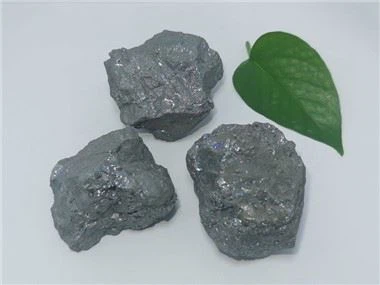

How metal silicon (industrial silicon) is refined
Dec 26, 2022
Metallic silicon, also known as industrial silicon or crystalline silicon, is usually produced by reducing silicon dioxide with carbon in an electric furnace. Silicon metal is a product smelted from quartz and coke in an electric furnace. The main component silicon content is about 98% (in recent years, 99.99% of Si content is also included in metal silicon), and the remaining impurities are iron and aluminum. , calcium, etc. Its main use is as an additive to non-ferrous alloys and as a starting material for the production of semiconductor silicon and organic silicon.
In my country, metal silicon is usually classified according to the content of three main impurities: iron, aluminum and calcium. According to the percentage content of iron, aluminum and calcium in metal silicon, metal silicon can be divided into different grades such as 553, 441, 411, 421, 3303, 3305, 2202, 2502, 1501, 1101 and so on.
The production of metal silicon adopts the carbothermal method, that is, the method of smelting in submerged arc furnaces with silica and carbonaceous reducing agents. The silicon obtained in this way has a purity of 97% to 98%, and such silicon can generally be used in metallurgical applications. If higher-grade silicon is to be obtained, it needs to be refined to remove impurities to obtain metallic silicon with a purity of 99.7% to 99.8%.
The smelting of metal silicon with quartz sand as raw material includes several steps of quartz sand block making, preparation of charge and submerged arc furnace smelting.
Carbothermic Reduction in an Electric Arc Furnace
The main refining process occurs in a submerged electric arc furnace (SAF) at temperatures around 1,800–2,000°C:
Chemical Reaction:
SiO2+2C→Si+2COSiO2+2C→Si+2CO
The quartz and carbon materials are fed into the furnace, where an electric current generates extreme heat.
Molten silicon settles at the bottom, while gaseous carbon monoxide (CO) escapes.
Impurities form a slag layer that is removed.
Generally speaking, high-quality quartz sand will be directly used to produce high-grade quartz glass products, and even be processed into gem-level products such as crystals and tourmalines. The grade is slightly lower but the reserves are larger, the mining conditions are slightly better, and the surrounding electricity is cheaper, which is suitable for the production of metal silicon.
At present, the production process route of the carbothermal method for the production of metal silicon in China: silica is generally used as raw material, petroleum coke, charcoal, wood chips, low ash coal, etc. Metal silicon is reduced, which is a slag-free submerged arc high-temperature melting process.
Therefore, although metal silicon is extracted from silica, not all silica is suitable for making metal silicon. The ordinary sand we see in our daily life is not the real raw material of metal silicon, but the above-mentioned quartz sand used in industrial production, and it has undergone multi-step reactions to complete the transformation from sand to metal silicon.
Applications of Industrial Silicon
Metallurgical uses: Aluminum alloys, silicones, silicones.
Solar industry: Further refined for photovoltaic cells.
Electronics: Ultra-pure silicon for semiconductors.
Any inquiry, please email to me info@kexingui.com