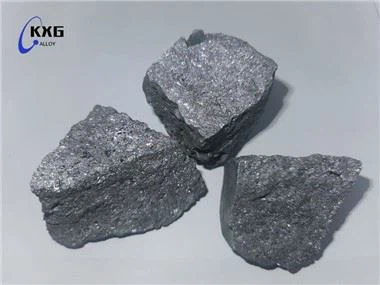

Are High Carbon Silicon The Same As Silicon Carbide?
Jan 30, 2026
No, high carbon silicon and silicon carbide are two completely different substances with significant differences in chemical composition, structure, properties, and applications.
In simple terms:
High carbon silicon: A mixture of silicon (Si) and carbon (C), which can be understood as a silicon iron alloy or silicon carbon alloy containing an excess of carbon.
Silicon carbide: A compound of silicon (Si) and carbon (C), with a strict atomic ratio and stable crystal structure.
For a clearer understanding, here is a detailed comparison:
1. High carbon silicon
Essence: A silicon-based alloy or raw material. It is not a fixed compound but a commercial name referring to a silicon-carbon mixture with a very high carbon content (usually between 10% and 40% carbon and around 55% to 70% silicon).
Structure and composition: Internally, it is a physical mixture of free silicon crystals, carbon (graphite), and a small amount of silicon carbide particles, without a uniform crystal structure. It may also contain impurities such as iron, aluminum, and calcium.
Production Process: Silicon dioxide (quartz sand) is typically produced under specific process conditions in an electric arc furnace by reducing silica (quartz sand) with carbonaceous reducing agents (such as petroleum coke or coal).
Main Uses:
Steelmaking Deoxidizer and Carburizer: In steelmaking, it simultaneously deoxidizes and carburizes molten steel.
Raw Material for Ferrosilicon Alloy Production: Serves as an intermediate product in the smelting of ferrosilicon alloys.
Raw Material for Silicon Carbide Production: Can be used as one of the furnace charges in the smelting of green silicon carbide.
Physical Form: Usually irregular lumps, dark gray to black in color, and relatively brittle.
2. Silicon Carbide
Essence: A synthetic covalent compound with the chemical formula SiC. Silicon atoms and carbon atoms are bonded together in a 1:1 ratio by strong covalent bonds.
Structure and Composition: Has a very regular crystal structure (such as β-SiC in the cubic crystal system and α-SiC in the hexagonal crystal system), and its structure is very stable. High-purity silicon carbide has extremely low impurity content.
Production Process: Primarily synthesized through the Atchison process or more modern methods, at temperatures above 2000°C, from high-purity quartz sand and petroleum coke (carbon source) via a thorough chemical reaction.
Main Applications:
Abrasives: Due to its high hardness (Mohs hardness 9.2, second only to diamond and cubic boron nitride), it is widely used for cutting, grinding, and polishing.
Refractory Materials: Possesses excellent high-temperature strength, thermal shock resistance, and corrosion resistance.
Ceramic Materials: Used in the manufacture of high-performance structural ceramic parts.
Semiconductor Materials: Especially wide-bandgap semiconductors, used in the manufacture of high-temperature, high-frequency, high-power electronic devices (such as LEDs, power electronic devices), radio frequency devices, and core electronic control components for new energy vehicles.
Advanced Composite Materials: Used in aerospace, aviation, and other fields.
Physical Forms: Can be processed into various forms such as powder, whiskers, wafers, and sintered bodies. Colors: Black, green.
If you are interested in any product, please let me know. Our email: info@kexingui.com